
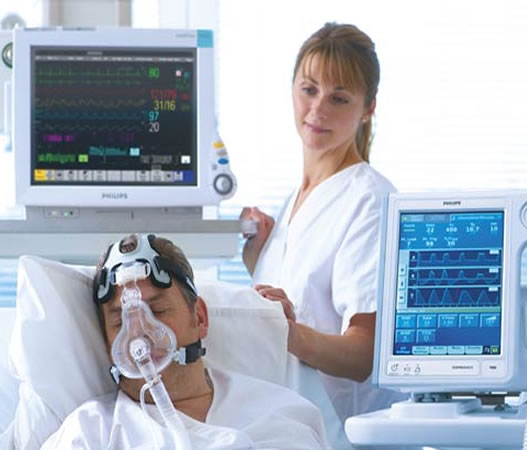
Ventilation
In a healthy patient, spontaneous ventilation ensures the renewal of oxygen (inspiration) and the evacuation of carbon dioxide (expiration). It's breathing.
Artificial ventilation is a technique to help a patient who cannot provide ventilation himself. Its purpose is to partially or completely support the respiratory work of the patient. As a result, it improves gas exchange by assisting the respiratory muscles.
Objectives of the ventilation:
- Improve blood gases
- Decrease the effort of the respiratory muscles
There are different models and brands of fans (or respirators), which offer several modes of settings and options (alarms, batteries, monitoring parameters...). Depending on the patient's pathology and profile, the doctor prescribes the most appropriate parameters.
There are two types of artificial ventilation:
NON-INVASIVE VENTILATION
It is done by means of a ventilator, a circuit (possibly of a system of humidification) and an interface (mask nasal, bucco-nasal, and mouthpiece).
INVASIVE VENTILATION
It is done through a fan, a circuit (possibly a humidification system) and becomes invasive with the use of a tracheal cannula.